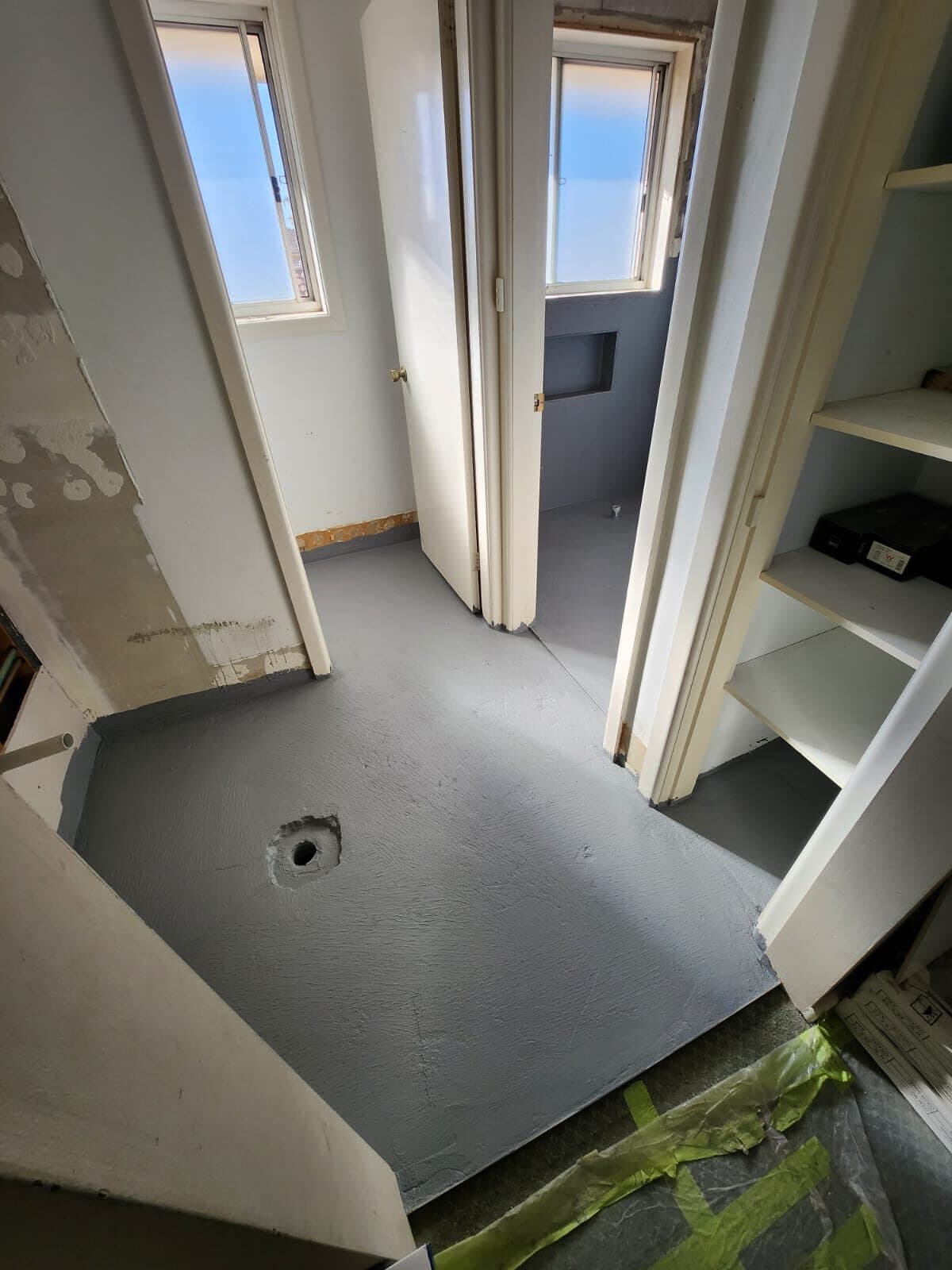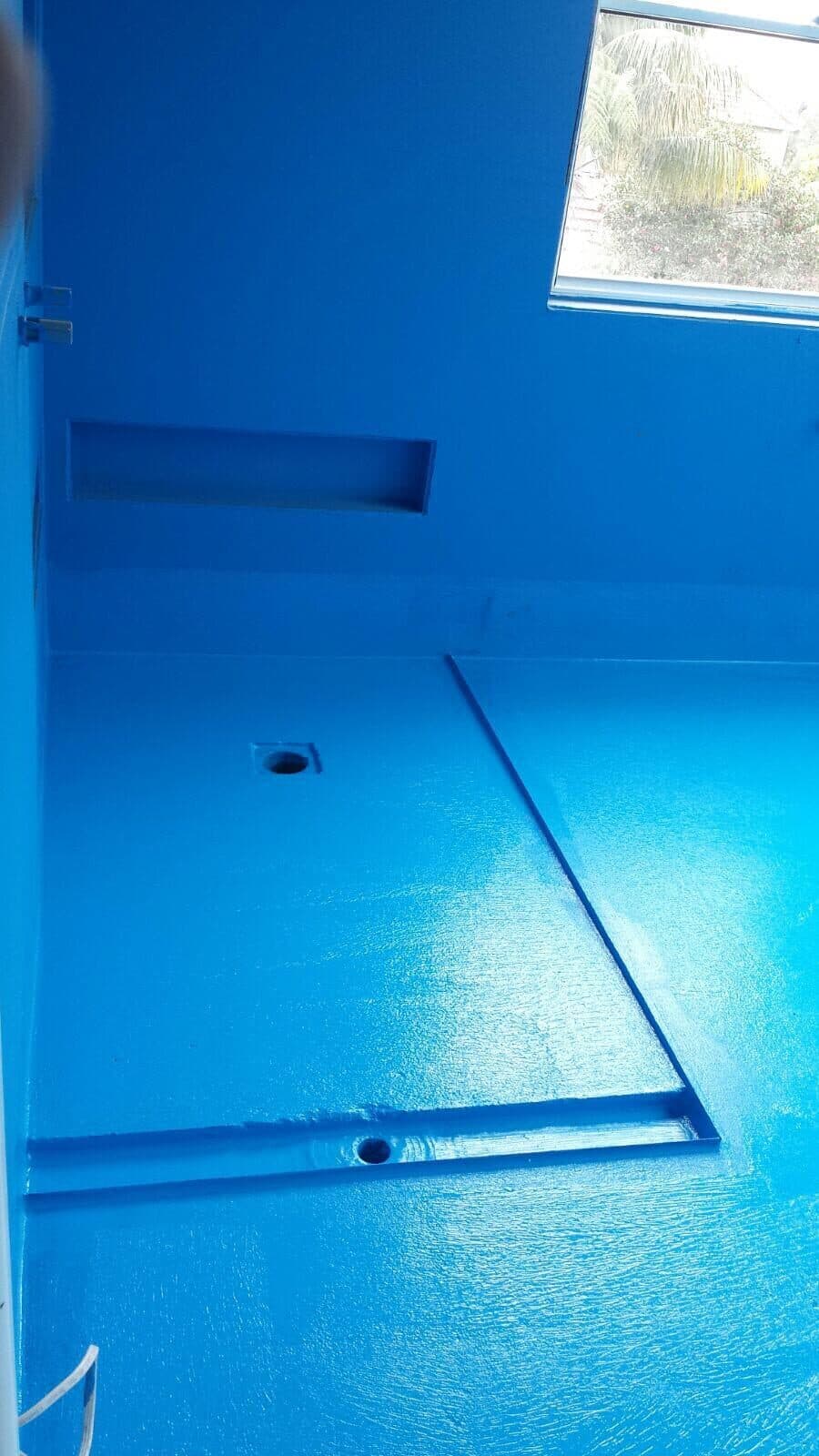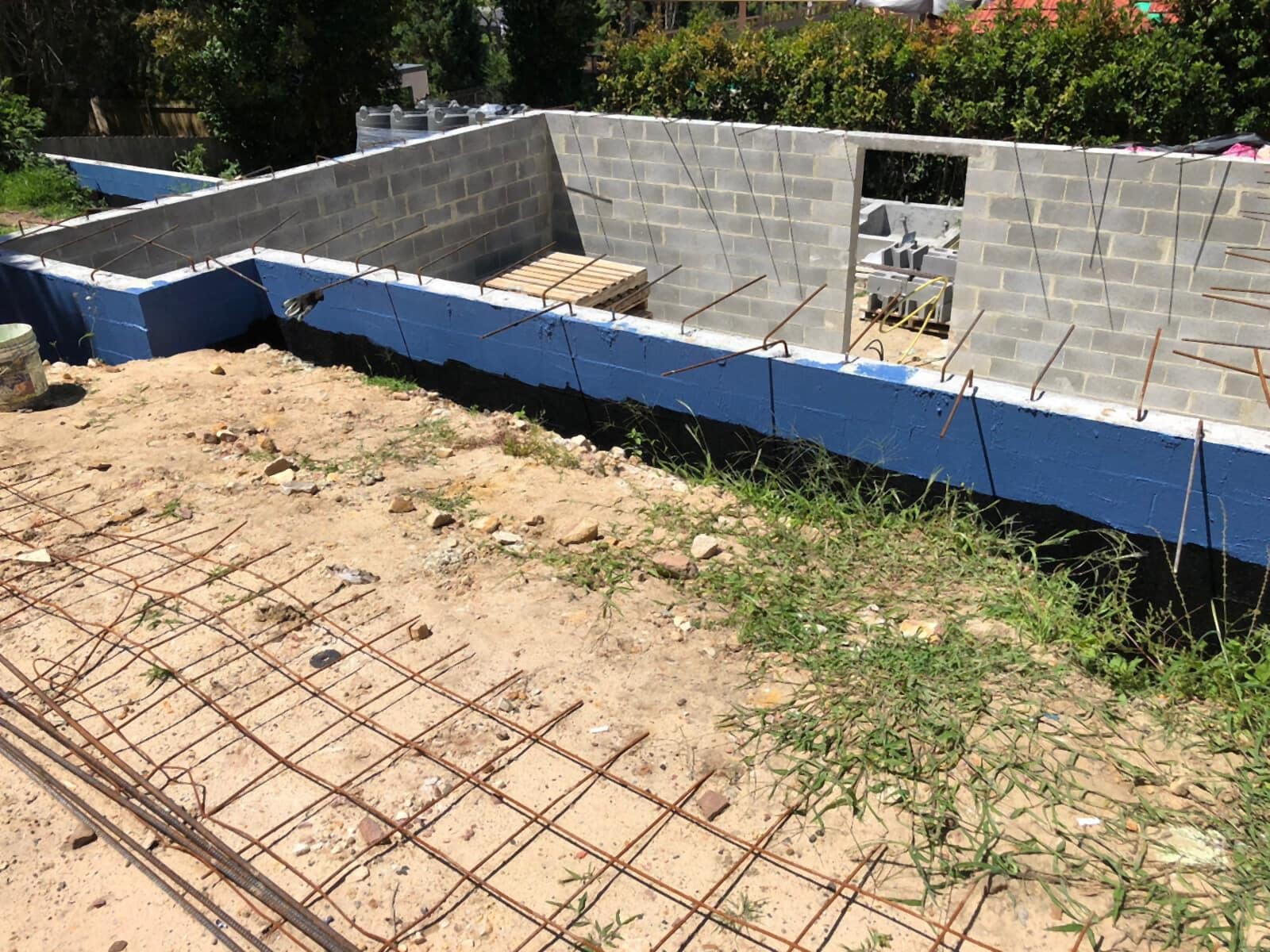
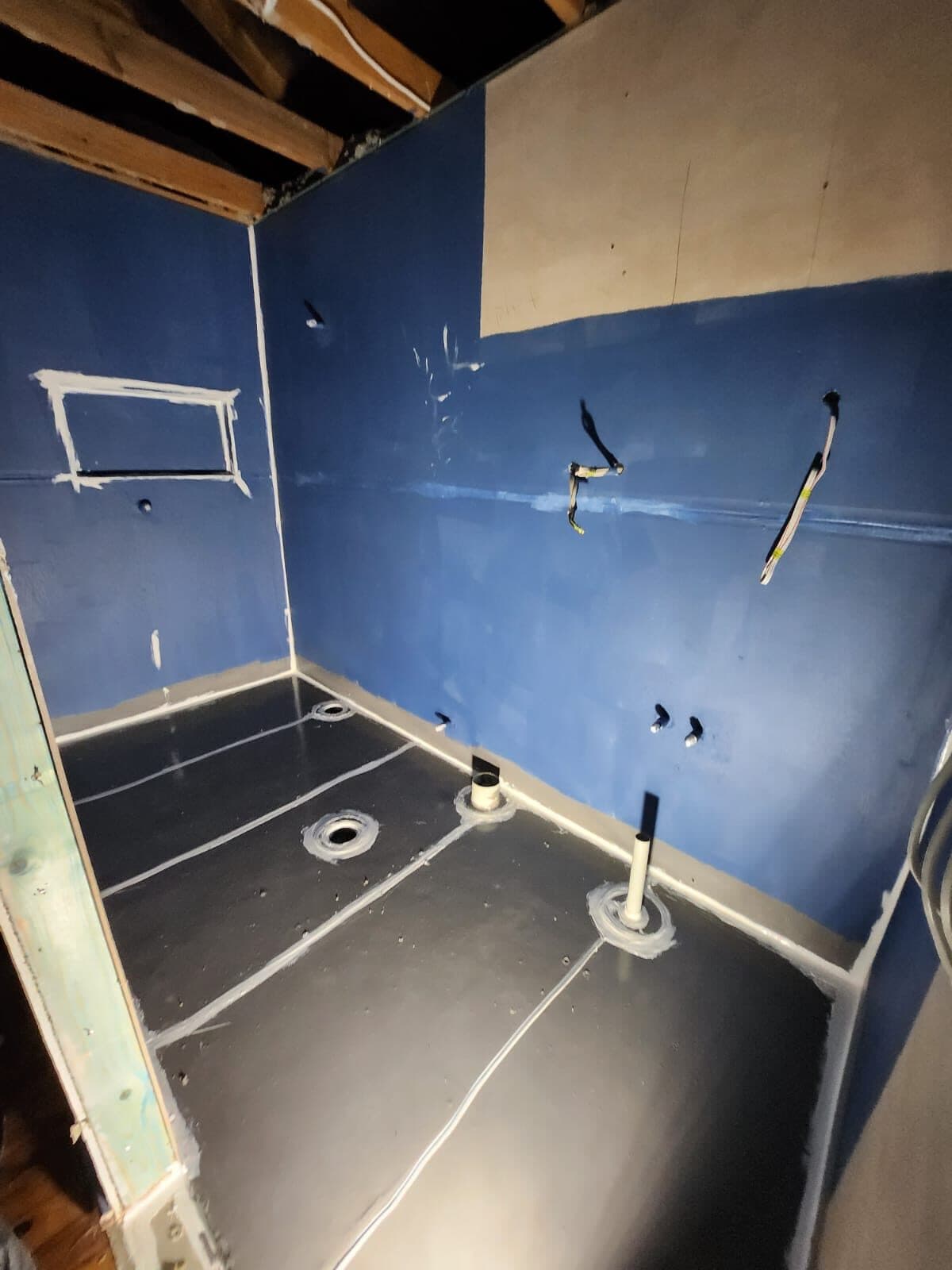
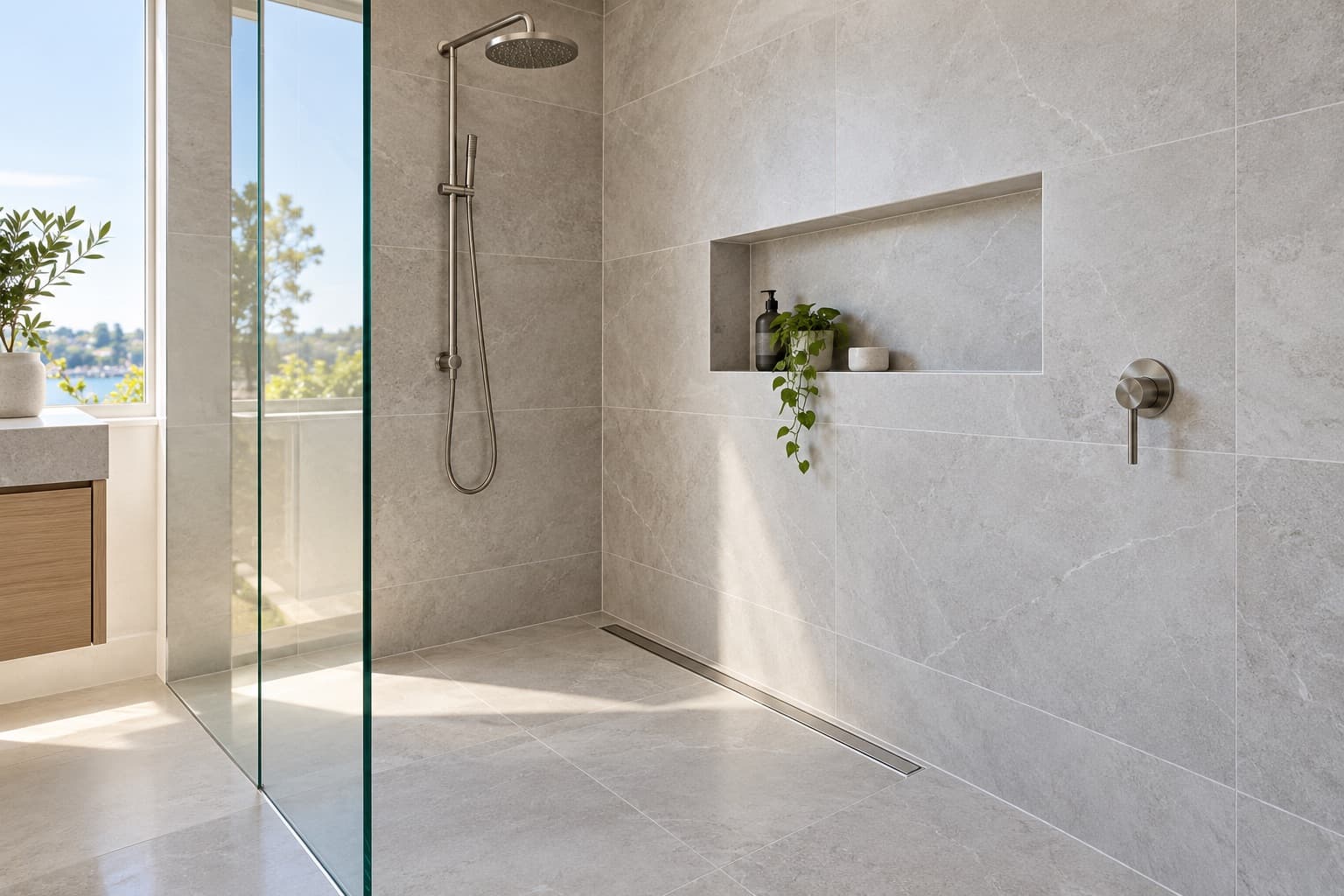
The code itself offers AS 3740 as one way to meet its wet-area rules. For balconies and roofs, it calls up AS 4654 directly. Our bathroom and shower waterproofing and balcony waterproofing pages cover the work itself.
The key numbers at a glance
| Where | What the code asks for |
|---|---|
| Shower floor, hob and step-down | Waterproof |
| Shower walls | Waterproof to at least 1800 mm above the floor base |
| Corners inside the shower | Waterproof for at least 40 mm either side |
| Bathroom floor outside the shower | Water resistant on concrete or fibre-cement, waterproof on timber; the wall-to-floor join waterproof |
| Wall beside a bath (no shower) within 75 mm | Water resistant to 150 mm above the bath |
| Laundry and toilet floors | Water resistant, including where wall meets floor |
| Wall beside a tub or basin within 75 mm | Water resistant to 150 mm above it |
| Floor slope (fall) to a drain | Between 1:80 and 1:50 |
| Membranes | Must meet AS/NZS 4858 |
| Balconies, terraces, flat roofs | Membranes to AS 4654.1, designed and installed to AS 4654.2 |
What is AS 3740?
AS 3740, Waterproofing of domestic wet areas, sets the minimum rules for materials, design and installation inside houses and apartments. Standards Australia lists AS 3740:2021 as the current edition.
The table above shows where the code wants waterproofing in a house. A few more rules sit outside it:
- Tap and spout holes in flat surfaces beside a bath must be waterproof.
- Every shower must have a floor drain.
- A shower without a hob needs a step-down of at least 25 mm, or a waterstop at its edge. Our guide to walk-in and hobless shower rules explains the options.
- South Australia adds a rule for the wall behind a washing machine. The national code, which NSW follows, does not.
Because waterproof and water resistant are different levels, a wet-area quote should say which areas get a full membrane.
What about laundries?
Yes, though less than a shower. The floor, the join between wall and floor, and the wall beside a tub within 75 mm must all be water resistant. Our laundry waterproofing guide covers timber floors, floor drains and apartments.
AS 3740 scope and the Part 10.2 clauses
AS 3740:2021 scope and edition
- AS 3740:2021 covers Class 1, 2 and 4 buildings under the NCC. It also covers wet areas in other building classes as if they were part of a Class 2 or 4 building.
- It was published on 23 July 2021 and replaced the 2010 edition.
Clause references in ABCB Housing Provisions Part 10.2 (NCC 2022)
- 10.2.2: shower area. Floor waterproof, including hob or step-down; walls waterproof to at least 1800 mm above the floor substrate; wall junctions within the shower area waterproof for at least 40 mm either side.
- 10.2.3: area outside the shower. Concrete and fibre-cement floors water resistant; timber-based floors waterproof; wall-to-floor junction waterproof.
- 10.2.4: bath without a shower. Wall within 75 mm of the bath water resistant to 150 mm above it; tap and spout penetrations in horizontal surfaces waterproof.
- 10.2.5: laundries, toilets, basins, sinks and tubs. Floor and wall-to-floor junction water resistant; wall within 75 mm of a fixture water resistant to 150 mm above it. Laundry floors and junctions are covered by NCC 2022 Part 10.2.
- 10.2.12: floor falls of 1:80 to 1:50 to a floor waste.
- 10.2.15 to 10.2.18: showers without a hob (step-down of at least 25 mm, or a waterstop).
What changed between AS 3740-2010 and AS 3740:2021?
For a homeowner, the change that matters is the paperwork. A quote, specification or certificate written today should name AS 3740:2021 and NCC 2022. It should not name the 2010 edition or "Part 3.8.1", the old code section.
NCC 2022 was the first edition of the code to refer to the 2021 edition. The Australian Building Codes Board (ABCB) says the house wet-area rules also moved and were split into "where" and "how". New defined terms gave "waterproof" and "water resistant" precise meanings.
In practice, a detail from the 2010 era is not automatically wrong. Standards Australia sells the full text of either edition. Free copies offered online are usually unofficial and often out of date.
NCC 2022 changes in detail
From the ABCB overview of changes (health and amenity), 7 July 2022:
- NCC Volume Two Part 3.8.1 became Part 10.2 of the new ABCB Housing Provisions, with new deemed-to-satisfy provisions for wet-area and external waterproofing.
- H4D2 now sets where protection is needed. A new clause, H4D3, sets the materials and how they are installed.
- New defined terms support the wet-area requirements.
- For other building classes, the waterproofing and water resistance needed beside baths and spas, and the use of fibre-cement sheet flooring, were clarified.
What is AS 4654?
AS 4654 is the Australian Standard for waterproofing membranes used outside, above ground. It has two parts:
- Part 1 sets the rules for the membranes themselves.
- Part 2 sets the rules for designing and installing them.
Both parts date from 2012. Standards Australia lists them as pending revision, so a new edition may follow.
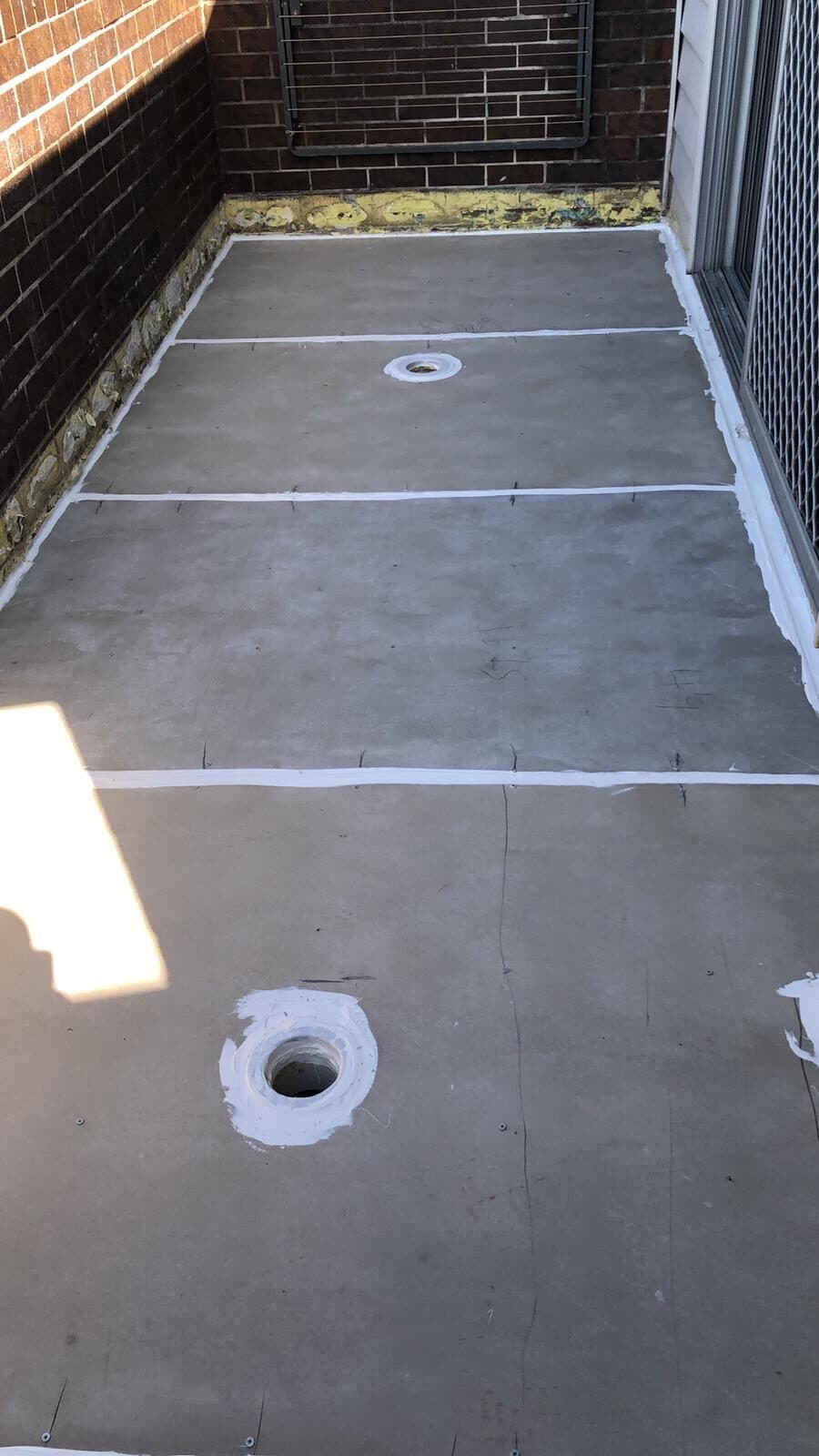
For houses, the code applies AS 4654 to flat roofs, roof terraces, balconies and terraces. The membrane must meet Part 1, and the system must be designed and installed to Part 2. Any other membrane or design needs its own approval route (a Performance Solution). The ABCB warns that rooftops, decks and balconies are prone to letting water in, especially over rooms inside.
AS 4654 editions and NCC clause H2D8
- Current editions: AS 4654.1-2012 (membrane materials) and AS 4654.2-2012 (design and installation), both listed as pending revision.
- NCC 2022 Volume Two, Part H2, deemed-to-satisfy provision H2D8 (external waterproofing): covers flat roofs, roof terraces, balconies and terraces. Membranes must comply with AS 4654.1; the system must be designed and installed in accordance with AS 4654.2.
- Other external membranes or designs need a Performance Solution.
- The ABCB explanatory note on H2D8 says roof-top spaces, decks and balconies, particularly over internal rooms, are prone to water entering the building.
How does the National Construction Code apply in NSW?
The NSW Government says the current edition is NCC 2022 Amendment 2. It has been in effect since 29 July 2025. NSW will adopt NCC 2025 on 1 May 2027.
Any guide or quote that still talks about "Part 3.8.1" is quoting the code from before 2022.
For a house's wet areas, a builder can follow the code's own rules in full. Or they can follow its basic rules on where waterproofing goes and the fall, together with AS 3740. Either way, a membrane only counts as waterproof if it meets AS/NZS 4858.
NCC 2022 wet-area clauses for houses
- Performance requirement: H4P1. Deemed-to-satisfy clauses: H4D2 (where protection is needed) and H4D3 (materials and installation).
- The detail sits in ABCB Housing Provisions Part 10.2.
- Two ways to comply (ABCB NCC Navigator): follow Part 10.2 in full, or follow 10.2.1 to 10.2.6 and 10.2.12 together with AS 3740.
- A membrane counts as waterproof when it complies with AS/NZS 4858 (Housing Provisions 10.2.8).
Do you need a licence to do waterproofing in NSW?
Yes, for jobs over $5,000, counting labour, materials and GST. Above that, anyone doing home building or trade work in NSW, including waterproofing, needs a contractor licence. They need it to do, advertise or contract for the work.
Unlicensed work can be fined $22,000 for a person and $110,000 for a company.
The same $5,000 line applies to the paperwork. Residential building work over $5,000, including GST, needs a written contract:
- $5,000 to $20,000: a small jobs contract.
- Over $20,000: a fuller home building contract. The contractor must have Home Building Compensation cover in place, and give you the certificate, before taking any payment.
- Deposit: never more than 10%.
You can check any contractor on the NSW Government licence register.
Where the licence definition sits
For licensing, waterproofing means any protective treatment of a home to keep water or moisture out, and the treatment of wet areas such as a shower to stop water escaping. The full definition is in Schedule 4 of the Home Building Regulation 2014.
Can I do my own waterproofing?
It depends on the value of the job and where you live. The licence rule above applies to waterproofing work over $5,000.
Owner-builders have a separate rule. You need an owner-builder permit to do or supervise work over $10,000, including GST, on your own home without a licensed builder supervising. It applies to a single house, dual occupancy or secondary dwelling, where the work needs development consent or is complying development. Permits cannot be issued for strata apartment renovations. If you are unsure which rule covers your job, ask NSW Fair Trading before you start.
The legal question is only half of it. The skill is in the details listed under common mistakes below, and they all disappear under tiles within days.
Does waterproofing need to be certified?
Sometimes. If the work is part of a development consent or a complying development certificate, the certifier inspects the waterproofing before it is covered. They commonly ask the waterproofer for a signed certificate. Our guide to waterproofing certificates in NSW covers the inspection, the certificate and what it should record.
How should an area be prepared for waterproofing?
Most of the preparation is the waterproofer's job, and the code sets the bar. The surface must be clean, dust free and free of dents and flaws. A hob must be fixed to the floor and sealed against the wall, with every gap made flush. It cannot be built from timber.
Your part is simpler:
- Fix any existing leak first, such as a dripping tap or a failed drain pipe.
- Give a wet floor or wall time to dry.
- Clear the room and the path to it.
- Plan to be without the room for longer than the membrane day. Each coat has to dry (cure) before the next, and the membrane cures again before tiling. Ask for the days out of use to be written on the quote.
What are the most common waterproofing mistakes?
These faults show up as leaks, and the code covers each one:
- Missing or wrong bond breakers. These go in every wall, floor and hob corner, and at movement joints, and must suit how flexible the membrane is. Without them, the membrane is stretched across the joint and splits when the building moves.
- The membrane not sealed into the drain. On concrete floors, the membrane must finish at or in a fitting called a drainage flange. If it stops short, water runs under it at the drain.
- Membrane stopping short. Shower walls need waterproofing to at least 1800 mm. A timber bathroom floor needs it across the whole room, not just in the shower.
- Unsealed board edges. Every cut edge of water-resistant plasterboard that water could reach must be waterproofed, including the bottom edge over a shower base.
- The screen on the wrong side of the hob. A screen on a hob must line up with its shower side, or overhang into the shower. That keeps water on the side the membrane was built for.
- Too few coats, or no time to cure. Membranes work at a set thickness. Fewer coats, or tiling before the membrane cures, leaves a film that looks complete but is not.
Clause references for preparation and common mistakes
All in ABCB Housing Provisions Part 10.2 (NCC 2022):
- 10.2.22: substrate clean, dust free and free of indentations and imperfections before membrane application.
- 10.2.16: hobs secured to the floor and sealed against the wall, all gaps and joints made flush; timber not to be used to construct a hob.
- 10.2.27: bond breakers at all wall/wall, wall/floor and hob/wall junctions and at movement joints, compatible with the flexibility class of the membrane.
- 10.2.29: on concrete floors, a drainage flange installed with the membrane terminated at or in it.
- 10.2.2 and 10.2.3: membrane extent (shower walls to at least 1800 mm; timber-based floors waterproof across the whole room).
- 10.2.26: water-resistant plasterboard. Every cut edge that could be affected by water waterproofed, including the bottom edge over a shower base.
- 10.2.32: a shower screen on a hob sits flush with the shower side of the hob or overhangs into the shower.
What this means for you
When you get quotes, ask each one two things:
- Which standard the work is installed to: AS 3740 or the code's own rules for a wet area, or AS 4654.2 for a balcony or roof.
- How far the membrane goes.
For costs, see how much waterproofing costs in Sydney. For how long a membrane should last, see how long waterproofing lasts. For a free written quote, send photos of the area through our enquiry form, or call 0451 662 300.
Sources (11)
- 1.Standards Australia: AS 3740:2021 (checked 12 October 2026)
- 2.ABCB Housing Provisions, Part 10.2: wet area waterproofing (checked 12 October 2026)
- 3.ABCB: overview of changes, health and amenity (7 July 2022) (checked 28 October 2026)
- 4.Standards Australia: AS 4654.1-2012 (checked 12 October 2026)
- 5.Standards Australia: AS 4654.2-2012 (checked 12 October 2026)
- 6.NCC 2022 Volume Two, Part H2: damp and weatherproofing (checked 12 October 2026)
- 7.NSW Government: how to comply with the NCC (checked 12 October 2026)
- 8.ABCB NCC Navigator: waterproofing houses (checked 12 October 2026)
- 9.NSW Government: waterproofing work (checked 12 October 2026)
- 10.NSW Government: building contracts (checked 12 October 2026)
- 11.NSW Government: when an owner-builder permit is needed (checked 12 October 2026)